Translate

Thursday, February 25, 2021

The Jackal from Rome crossed the Arctic Circle, 70° North. Welcome to Norway!

First C2-C3 record of a Golden Jackal (Canis aureus, L1758) in Norway 

by Ovidiu C. Banea

25.02.2021

Announcement came from NRK News (here), via Morten Kure Kattenhøj from Denmark On 14th of July 2020 a wild canid was photo trapped in Troms og Finnmark county, Norway. 


Initially, the Norwegian Environmental Protection Agency (SNO) in Lakselv was looking for a Racoon dog in the area. "It took some time to confirm that it was a golden jackal. Now we are also trying to get DNA from it" said the local predator contact in Lakselv, Tore Kåven. Due to winter and bad weather, Kåven has not actively searched for the golden jackal. But the sound, it is unique, he says.

Erik Lund, senior adviser, game section, Norwegian Environment Agency

Senior adviser in the Norwegian Environment Agency, Erik Lund, received the information about the golden jackal only two days ago (23rd of February 2021). Lund said that you never cease to be surprised (NRK News).

Senior researcher John Linnell at the Norwegian Institute for Natural History (NINA) declared for NRK News that the observation of a completely new species up in Finnmark is spectacular. "It does not happen often. And it is extra special when it comes to a species that we never imagined would become part of the Norwegian fauna"


John Linnell at the Norwegian Institute for Natural History (NINA)

GOJAGE

This record remains a C2-C3 evidence (GOJAGE Criteria, Hatlauf et al, 2016). The area where the jackal was observed in Norway it seems as a suitable habitat.

Lakselv is the largest settlement and administrative centre of the municipality Porsanger. Here is the world's northernmost pine forest (Porsanger climate). Its protection is therefore one of the major objectives of Stabbursdalen National Park. 

Stabbursdalen (source) is the most northernly habitat for many species, including black grouse and osprey, and wetlands are important breeding ground, especially for ducks. Old hollow pine trees provide good nesting places for the goldeneye and goosander. Along the river, willow and sedge, with pine woodland behind, support a rich bird life. 

Porsanger (source) is an area of rich and varied bird fauna. Here one can find such species as Pine Grosbeak. Away from the woodlands, it is the surrounding wetlands that have the greatest diversity. During spring, thousands of Red Knots stop to rest and feed along the shores of Porsangerfjord.


                            Photo: Tore Kåven


Tuesday, February 23, 2021

ALERT GOJAGE: Golden Jackal extermination harvest quotas in Romania

Golden Jackal ALERT in Romania! The "last bullet" is giving jackals an opportunity.

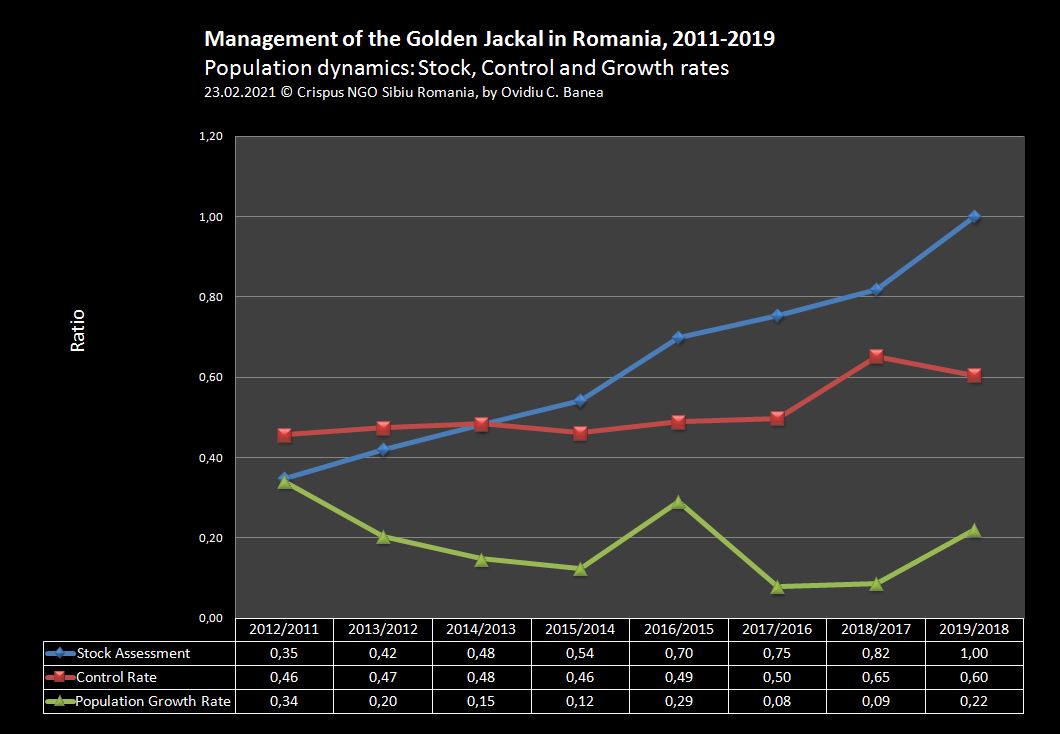
The lethal management and increased control rates are not sufficient to control the golden jackal population size in Romania. Despite increased 65% and 60% control rates the stock assessment increased by 22% during the last hunting season (2019-2020)

During the last week the Ecology Department of NGO Crispus Sibiu Romania started a campaign to make public the difficult management of the golden jackal species in Romania, mostly in the last two hunting seasons when the Romanian Game Management Authority approved harvest quotas (control rate) of 81% and 80%. During the hunting season 2019-2020 a total number of 9.474 jackals were removed.

In Romania, during the last two hunting seasons there is an approved harvest quota of more than 80% from the Stock Assessment.

Proposed and approved Harvest Quota


Realized Quota "Habitats Directive" species of interest Mammals Annex Va
Council Directive 92/43/EEC: Chamois and Golden Jackal Control Rates in Romania


MODEL ROMANIA: Red Foxes (Vulpes vulpes, L.1758) and Golden Jackal (Canis aureus, L.1758) Stock Assessment and Hunting Bag dynamics 2006-2019

Since harvest quotas was lifted to 80% in 2018, the jackals showed first a decreased population growth at 9% (2018-2019) when a pressure of 65% control rate was realized and an increased growing with 22% when the control rate was 60% and 9.747 jackals were harvested.

Golden jackal population dynamics related to management measures in Romania

Game species hunting bag data in Romania 2014-2020


Hilac (Canis aureus moreoticus, I. Geoffroy Saint-Hilaire, 1836), 
Dolj County Romania, February 2021
Photo: Tea Oaches


Read about the full one week campaign!

The last episode (number 5) includes first "International Colloquium regarding European Concerns on jackal population ecology" held in Romania, 23rd of October 2011.

  1. Episode Golden jackal aggressive hunting and poaching in Romania (Aggressive Hunting)
  2. Episode Vulpea si hilacul in Austria, Ungaria, Romania si Bulgaria (Red Foxes and Jackals)
  3. Episode Ce mananca hilacul si dece nu mai au valoare trofeele (A fur costs 150 EUR)
  4. Episode Alerta de Mediu Crispus NGO Sibiu Romania (Environmental Alert)
  5. Episode Letal Management and conservation questions in Romania ("Jackal died", "Hilacul was born")


Ecology Department of Crispus NGO Sibiu Romania

Contact email: crispusngosibiu(at)gmail.com

Monday, February 15, 2021

The Golden Jackal: Legal Framework 2021 applicable to EU


The Jackal is NOT an Invasive Alien Species

The Golden jackal Canis aureus moreoticus is a COMMUNITY INTEREST SPECIES  same like chamois Rupicapra rupicapra

Jackal in Danube Delta, Romania Photo: Carlo Galliani

The golden jackal (​Canis aureus) is a ​Community Interest species​ ("Habitats Directive"92/43/EEC) listed in Annex Va together with pine marten (​Martes martes​), European polecat (Mustela putorius​) and chamois (​Rupicapra rupicapra​). Monitoring of conservation status is an obligation arising from Article 11 of the Habitats Directive for all habitats (as listed in Annex I) and ​species​ (as listed in ​Annex​ II, IV and ​V​) of Community interest.

Consequently, this provision is not restricted to Natura 2000 sites and data need to be collected both in and outside the Natura 2000 network to achieve a full appreciation of the conservation status.

The main results of this monitoring need to be reported to the Commission every six years according to Article 17 of the Directive. Article 14 places a requirement for further surveillance of exploited species of flora and fauna listed in Annex V where necessary. Only after monitoring and scientific reports to the Commission, management measures can be assessed. When management measures are applied in case of ​Community Interest species ​like the golden jackal or chamois a series of hunting methods should be avoided. These hunting methods which are ​prohibited are listed in the Annex VI of the "Habitats Directive" 92/43/EEC. 


GOJAGE posted the work A European Concern? Genetic Structure and Expansion of Golden Jackals (Canis aureus) in Europe and the Caucasus written by Rutkowski R et al in 2015 and published in PLoS ONE which confirms the natural spreading of jackals removing suspicions of being of allochthonous origin in the new successful settlement of natural areas from Estonia. The authors suggest developing cross-boundary strategies for management and documents like those developed for Europe’s other large carnivores.


Based in this Original Article, the EU published a report on their weekly Science for Environment Policy News Alert, Issue 443, 21 January 2016 in which explained the legal situation and the reasons to do not consider jackals an invasive alien species.

CLEANING UP THE CONFUSION In LCIE Note by John Linnell

In June 2015, in Biodiversity and Conservation Journal, in original paper Legal implications of range expansions in a terrestrial carnivore: the case of the golden jackal (Canis aureus) in Europe (here), the authors Arie Trouwborst, Miha Krofel & John D. C. Linnell addressed specific questions regarding the consideration of the golden jackal as classified an (invasive) alien species in countries where it did not formerly occur.  They showed that current international legal obligations limit the freedom of countries to decide how they wish to deal with newly arriving golden jackals. 

Later on, in July 2015, John D.C. Linnell synthesized and resumed these legal implications in a note of  LCIE Large Carnivore Initiative for Europe.

The authors of Legal implications of range expansions in a terrestrial carnivore: the case of the golden jackal (Canis aureus) in Europe. Biodivers Conserv 24, 2593–2610 (2015). https://doi.org/10.1007/s10531-015-0948-y
 
Arie Trouwborst

Miha Krofel

John Linnell

Saturday, February 13, 2021

The Jackal from Rome on the way to Stockholm

 The Lady Wolf from Sweden is waiting the Jackal from Rome

by Ovidiu C. Banea and Alex Gridan


Golden Jackal in Danube Delta 2013, Photo: Carlo Galliani 


Wolves in Sweden: HERE

Northern latitudes are now naturally colonized by the European golden jackal. In Denmark and Finland there were individual sightings without known survival or reproductive family groups. According to an informed note to GOJAGE in 2013, after the W Estonia, Baltica wildlife winter survey when we assumed a reproductive population cluster, have been growing since 2011 when locals started to here spontaneous howling, Professor Nikolai Spassov from NHM in Sofia Bulgaria stated that the golden jackal species would not survive in the boreal biogeographical region without the help and the intervention of humans. There is a risk and limitations of a single indirect method for golden jackal species monitoring in new natural areas. Species monitoring and complementary methodology is needed in Sweden to confirm a possible record of a new mammal species at such latitudes.

On 12th of February 2021 jackal possible footprints and track appeared in the region of Grimsö Wildlife Research Station (wildlife management, ecology and hunting) from Örebro County in Sweden. The photographs were analyzed by two Romanian GOJAGE members, Ovidiu Banea and Cristian Remus Papp and by Adrian Gridan from National Institute for Research and Development in Forestry “Marin Dracea” (I.N.C.D.S.) Brasov, Romania. The uploaded pictures might  show prints of jackal but without additional indirect or direct methods this observation remains C4 - No evidence (GOJAGE Expert Criteria) or C2 - Weak evidence (SCALP modified, see in Hatlauf et al, 2016).


Source: AICI
The Lady Wolf, Photo: Rick Heeres, Nov 2019

Canid footprints, Photo: Rick Heeres, Dec 2020

After several interpretations and internal discussions, GOJAGE members are looking to perform a wildlife survey in a natural area of Northern Sweden. The tracks and snowy footprints are to be trained and guided within the Informal Group.

First golden jackal was discovered at the boreal biogeographic region in 2013, in West Estonia, Matsalu National Park, a wetland of 3000 ha of reeds in the Delta of Kasari River where are nesting 15.000 pairs of birds. Nearby it is a hunting terrain. These are the places where it can happen again a surprise like that from 2013.
 

The arrival of a golden jackal to Sweden is suspected to follow the same dispersal route like Racoon Dog, which first was spotted in Finland (1935) and Sweden (1945) before arriving to Central Europe. Technical data for new establishment is presented for Denmark Lille Vildmose wetland (OC Banea and F Böcker, 2017) and What about Sweden? (OC Banea, 2015).

Track in Sweden, near a wildlife research station at Grimso
Probable Wolf from Sweden
Photo Source: Here

Track in Romania, Photo: Cristian Remus Papp
Probable Wolf from Romania

Monday, January 11, 2021

All roads lead to Rome: The European Golden jackal crossed the Po River

Golden Jackal informal Group Europe (GOJAGE)

GOJAGE E-bulletin, 11th of January 2021


The story of the golden jackal and the River Po

All roads lead to Rome

Report by Luca Lapini (Italy) and Ovidiu C. Banea (Romania) 

A "wolf" was video recorded and presented via CorriereTV on the 1st of December 2020 in the parking area of Barilla Pedrignano, 40 km from Parma, Italy. This parking area is located near the E35 road between Milan and Bologna, on the southern (right) Po riverbed. On 8th of January 2021 a bioacoustic monitoring with GOJAGE protocol was performed by Luca Lapini near the wild canid observation and golden jackal specific howling were obtained. According to the scientific criteria and known species behavior these observations are consistent with territorial behavior or reproductive golden jackal groups.

Previously, on 6th of June 2017 we reported another alive jackal record in GOJAGE Letters after a golden jackal was video recorded near Mirandola (Modena region) by the field ornithologist Rafaelle Gemmato. Several consequent fieldwork and research was negative to prove the territorial behavior, at that time.

The record of the first territorial reproductive golden jackal species group on the southern part of the River Po induces an urgent action of collaborative work and assessment of the suitable habitat for the species which might spread to the Central and Southern Italy.

Luca Lapini (Italy) 

Italy: First ascertained reproduction of the European golden jackal South to the Po River


by Luca Lapini

Co-Founder GOJAGE
Zoologist, Dr in Natural Sciences
Zoology Section of the Frulian Natural History Museum of Udine


The European golden jackal (Canis aureus moreoticus) has been recorded in NE Italy first in 1984 (S. Vito di Cadore, Belluno Province). In 1985 it breeds near Udine (Friuli Venezia Giulia), after beginning a great expansion in whole Italy. At present it is widespread in whole north eastern Italy (Friuli Venezia Giulia, Veneto and Trentino-Alto Adige) with about 35 reproductive breeding groups (about 180-190 specimens) distributed from the sea level up to 1900 m a.s.l. 

Single dispersal youngs have been recorded also in Piedmont (2020), Lombardy (2017-2020) and Emilia Romagna (2017-2020). Up to now, anyway, the species has never reproduced South to the Po River. The recent segnalation of a single male around to a famous food farm of Parma Province (Emilia Romagna Region) has stimulated two bio-acoustic surveys to verify its local reproductive status, conducted by L. Lapini (Friulian Natural History Museum of Udine), P. Fedele (Forestry Services of the Italian Carabinieri Army), F. Nonnis Marzano (Parma University) and E. Fior (Ente Parchi del Ducato dell’Emilia Occidentale). The results of the standard GOJAGE bio-acoustic survey performed on January, 8th, 2021 gathered positive results, confirming the presence of a first reproductive group of Canis aureus South to the Po River. 

This statement is in agreement with various interesting phone-video recording taken from various agents in the night of private surveillance Service (IVRI) of the same famous feed farm. The reproductive group, anyway, dwells some kilometres far from this big feed farm, whose kind cooperation was essential to obtain certainty. A good example of cooperation between private citizen and public Administration in the protection of wildlife. 

Canis aureus in Italy is totally protected by National Law 157/1992, and in Europe by Habitat EU Directive 92/43 CEE (V Appendix). The new breeding group of golden jackal opens new interesting perspectives to the colonization of Central and southern Italy by Canis aureus.

Wednesday, April 8, 2020

Jackals "KOLE" and "NARIA". News from India and Sri Lanka

Crimes against golden jackal. Poaching and illegal trade. Case study in India.


by GOJAGE

The jackal illegal trade is not only in Europe.
Recently, our colleague from India, Malaika Mathew Chawla, MSc student at James Cook University, Australia published a paper related to this phenomenon (news here) and the paper you can download from here. Her main activity was performed in vicinity of Deussua, Goa Region, west part of India (location here). See pictures below.
In 2018, she studied human- jackal interactions and human-jackal co-adaptation in a semi-urban landscape in Sirlim, South Goa - India. The objective of the project was to understand how humans and jackals share space and resources, public perceptions about jackals, and document any associated traditional ecological knowledge. Her colleagues and her also created a repository of information that highlighted the mention of jackals in folk songs, folk tales and children's stories.

She wrote then: "This is an attempt to create a repository of information related to golden jackals (Konkani name: kole), specifically in the state of Goa. These texts have been retrieved from Goa State Central Library in Panjim, Dr Francisco Luis Gomes District Library in Navelim and a few online sources. Information collated from these books, documents and newspaper articles may give us insights into certain ecological aspects as well as human-jackal interactions that may have lead to the attribution of anthropomorphic qualities to jackals such as being 'cunning' or 'shrewd'. It is important to note that 'jackal' is often mistranslated from Konkani into English as 'fox'. This list maybe useful for students, researchers, historians or anyone interested in Goan wildlife and culture. This is not a comprehensive list; new additions to the list are most welcome." 

Now, she and her colleagues published an interesting paper on crimes and jackal illegal trade. Congratulations, Malaika!


Possible mange transmitted to jackals. Photo: Malaika M. Chawla

Jackals (Kole) in urban areas. Photo Malaika M. Chawla

Jackals (Kole) and cattle. Photo: Malaika M. Chawla

Mating pair in a rice field. Photo: Malaika M. Chawla


Possible two subspecies of jackals in Sri Lanka!

Canis aureus naria and Canis aureus indicus. The arrival of the continental jackal? 

LETTERS GOJAGE

by Ovidiu C. Banea and Chandika Jayaratne

Letter to GOJAGE:

I know this is not with concerns to Europe. But we in Sri Lanka also have golden jackal and I think I’m one of the only people in the island who goes looking for them in the jungles. Everyone else is more concerned with the Leopard. So I have come across a few of them on my journeys, but this one stood out. It seem to be a different color to its mate and every other individual I have seen. It doesn’t look like mange but the mate seems fine and I have never seen mange in the wild only on street dogs. I thought it was mud, but even though everything looks green we were way past the rains and did find any around, I have seen a few go wallow in the mud to cool off, but this didn’t look like it.

Canis aureus (possible Canis aureus naria) in Sri Lanka. Photo: Chandika Jayaratne

Canis aureus (possible indicus or Canis aureus aureus) in Sri Lanka. Photo: Chandika Jayaratne

Anyone would know what it is? Or is it just case of a color morph is that common? Lots of possibilities, could be just dirt as well.
Also caught one doing yoga, actually the mate scent marked the area with urine and then this individual went and rubbed and rolled over the location. Would love to know if that’s common and why they do that?

ANSWER:

Thank you so much for the beautiful pictures!!!
No, this is not mud. That seems to be the native Sri-Lanka Jackal Canis aureus naria. I remember many years ago we discussed about this. I was at that time looking to morphotypes and I saw the gray looking Sri-Lankan jackals.

In the attached picture I am sending you one from wikipedia and a pair from southern Sri-Lanka Uda Walawe National Park photographed in 2010 (FLICKR).


Now, look to Willpattu National Park three jackals! Photographed on the 1st of March 2020. I just found them on internet. These are on northwest of the island, more proximal to the mainland Indian peninsula, probably near to your region.

Photo: Dated 1st of March 2020. Source Facebook.: here

ARE THEY BELONGING TO THE SAME SUBSPECIES?

On these ones I am seeing the white mask and similarity with Canis aureus aureus or indicus? I am not sure (In Europe we have Canis aureus moreoticus). I would like to have an expert opinion.

But, your pictures are showing to me, two different subspecies of jackals (or variations, better say). At least morphologically they are separate.

I believe that Asian mainland indian subspecies Canis aureus aureus or Canis aureus indicus entered (colonized) Sri Lanka, in your pictures you got both of them. Then, the marking one, that is the intruder :). If they were both there for long time, I don´t know.. But from the distribution actual map (above) it seems that in Sri Lanka exists only Ca naria. The map should be actualized if this is true. Further research or scientific documentation would be excellent. 

At least, this is my personal opinion!
Good luck!

Ovidiu C. Banea,
Environmental Ecologist, MSc

Tuesday, November 12, 2019

Up to date situation of the golden jackal distribution in Italy, 2019

Nuove Presenze, problemi vecchi: il caso dello sciacallo dorato (Canis aureus) in Italia (here)

di Luca LAPINI

luca.lapini@comune.udine.it
Museo Friulano di Storia Naturale
Via Sabbadini 32, I-33100 UDINE


L’espansione dello sciacallo dorato in Italia sembra comunque aver attraversato tre fasi differenti.

–Prima fase (1984-1996): caratterizzata da discreto dinamismo, ha portato ad una prima segnalazione nel Veneto Prealpino, ad alcuni eventi di riproduzione nelle Province di Udine e Belluno e alla colonizzazione del Carso Isontino (Lapini et al., 2018).

–Seconda fase (1997-2008): caratterizzata da una evidente stasi dell’espansione e da una forte riduzione delle presenze complessive, ha comunque portato ad una prima riproduzione nel Muggesano (Istria settentrionale, Provincia di Trieste) e nelle valli del Natisone (Prealpi Giulie, Provincia di Udine), con presenze sempre più diffuse sul Carso Isontino (Provincia di Gorizia) (Lapini et al., 2018).

Terza fase (2009-2018): periodo di fortissima espansione, distinto da un ulteriore successo riproduttivo nel Veneto alpino (Provincia di Belluno), da vari episodi riproduttivi in Carnia (Prealpi Carniche, Provincia di Udine) e in Alto Adige (Provincia di Bolzano), nelle Valli del Natisone (Prealpi Giulie, Provincia di Udine), sul Carso Isontino (Provincia di Gorizia) e nelle aree steppico magredili dell’alta pianura pordenonese (Provincia di Pordenone) (Lapini et al., 2018).

Il primo gruppo riproduttivo di queste zone, localizzato nell’inverno 2015, è stato raggiunto dai lupi ai primi di ottobre 2016 ed è stato da questi decimato nel quadro di un fenomeno di intra-guild competition culminato con l’uccisione di una femmina dell’anno.


Nel 2017 si sono verificati diversi episodi riproduttivi anche sul Carso sloveno a ridosso del confine con la Provincia di Trieste, con la formazione di alcuni gruppi transfrontalieri. Questi ultimi, pur esercitando gran parte dell’attività nella finitima Repubblica di Slovenia, frequentano anche parte della Provincia di Trieste (zona di Medeazza, Malchina, Monte Lanaro-Fernetti, Alta Val Rosandra). Il grande dinamismo del 2017, forse stimolato proprio dall’incontro coi lupi, ha portato ad una grande dispersione di animali, con presenze isolate in Lombardia (Val Brembana, Provincia di Bergamo) e in Emilia Romagna (Provincia di Modena), a Sud del Po. In val Brembana (Provincia di Bergamo) un esemplare isolato è stato fototrappolato diverse volte tra la località di quota di Carisole (giugno 2017), la periferia del sottostante paese di Valleve e la località di Isola di Fondra (foto S. Locatelli 2017-2019).