Translate

Showing posts with label golden jackal. Show all posts

Sunday, November 5, 2023

The secrets of the Golden Jackal Alphabet

The Golden Jackal repertoire

by Ovidiu C. Banea

Golden Jackal talks, vocalizations, and even the "letters of the songs" the species plays during the night are now closer to being known by humans.

Eurasian Golden Jackal
Canis aureus moreoticus (Geoffroy, 1835)
Photo: Ovidiu C. Banea, January 2023

Briefly, the sound is a vibration that propagates as an acoustic wave through a transmission medium such as a gas, liquid, or solid. Acoustic waves that have frequencies lying between about 20 Hz and 20 kHz, the audio frequency range, elicit an auditory percept in humans. Sound waves above 20 kHz are known as ultrasound and are not audible to humans. Sound waves below 20 Hz are known as infrasound. Different animal species have varying hearing ranges.

Herz is the measure of frequency and 1Hz means 1 cycle/second (time unit).

During the Kerkini Jackal Week meeting, Biologist Uthpala Jayaweera and Professor in Zoology Sampath Seneviratne from the University of Colombo showed the participants sonograms of the Sri Lankan Golden Jackal subspecies - Canis aureus naria (Wroughton, 1916) recorded howls and suggested that the "alphabet" has 23 syllables forming 5 vocalization types.

Sri Lankan Golden Jackal
Canis aureus naria (Wroughton, 1916)
Photo: Charles J. Sharp, February 2022

But one of the most interesting aspects is that some of the Golden Jackal emitted sounds are perceived by us with a range between 500 and 2500 Hz. Even more, there are patterns of "singing jackals" that can be reproduced by humans.
by Biologist Uthpala Jataweera


Janka Durova (Slovakia), Sampath Seneviratne (Sri Lanka), 
Uthpala Jataweera (Sri Lanka), and Ovidiu C. Banea (Romania)
at Kerkini village, Greece (28.10.2023)
After a brief introduction to the spectral analysis of golden jackals sustained by Prof Seneviratne


Professor in zoology Sampath Seneviratne


Sonograms of the golden jackals were studied in Europe by Laszlo Szabo from Hungary (2009-2011), and by sound Engineer Carlo Comazzi (2015) in Italy. 

Source: Carlo Comazzi, Silvana Mattiello, Olivier Friard, Stefano Filacorda & Marco Gamba (2016): Acoustic monitoring of golden jackals in Europe: setting the frame for future analyses, Bioacoustics, DOI: 10.1080/09524622.2016.1152564

In Romania, the first sonograms were analyzed by Carlo Comazzi using recordings from "Danubius Jackal Camp" 2017, a wildlife survey organized in the Danube Delta Biosphere Reserve.

Spectral analysis of wild canid chorus was also used in wolves and the technique was suggested as an important tool complementary to other methods during the monitoring of the species. "Compared with other monitoring techniques (i.e., genetic analysis), bioacoustic analysis requires widely available informatics tools (i.e., sound recording set of devices and sound analysis software) and a low budget. Information obtained by means of chorus analysis can also be combined with that provided by other techniques. Moreover, howls can be recorded and stored in an audio file format with a good resolution (i.e. in “Wave” format), thus representing a useful tool for future listening and investigations, which can be countlessly employed without risks of time deterioration." Passilongo et al, 2015.

Wolves chorus spectral analysis (sonograms), Passilongo et al, 2015.


Spectral analyses of golden jackal howlings: 24th of October - 4th of November 2023


Wilde canids "singing" at Kerkini Lake


Red fox and Golden Jackal yip-howl ending of a specific howl followed by new linear vocalization

One or two golden jackal individuals chorus

Recording of a Golden Jackal territorial group. The low-frequency trace indicated a bigger size specimen. In the area wolves are present.

Two human voices imitating a jackal chorus

Comparative analysis between Golden Jackal howlings and human voices imitating the jackals

Hunting and spectral analysis of Golden Jackal chorus

The spectral analysis of wild canids shows different patterns if golden jackals are aggressively hunted with shot individuals almost every day, how occurred in the past at a waste dump in Trpanj (Croatia), where jackals replied from different angles at the same time during 2 minutes, with ununiform howlings and disorganized pattern. When there is NO Hunting or poaching, the Golden Jackal communicating behavior and territorial responses are organized with a consequent reply from every group with a total average of 27-35 seconds duration / each jackal chorus,


Thursday, November 2, 2023

Golden Jackals, Gray Wolves and Red Fox at Kerkini Lake National Park in Greece

Canis aureus, Canis lupus, and Vulpes vulpes together at Lake Kerkini National Park, Greece

23.10.2023-29.10.2023 Golden Jackal Week Workshop

by Ovidiu C. Banea


The mixture of individual patterns of vocalizations in wild canids is shown in the above picture. Note the overlapping noise with low frequency at the second 30´.

First sonogram realized with howls from Kerkini Lake NP by Carlo Comazzi Italy

Single Golden Jackal individual, call registered in 2010 in Slovenia by Miha Krofel

Spectral acoustics of a single jackal howling with specific yip-howl ending

Sonogram recorded at Kerkini Lake NP in which is visible the group transfer in a friendly environment, without hunting pressure.

After the barks (possibly Red fox barking at 700 Hz) together with a yip-howl-specific ending (1200-1300 Hz) a lower-frequency sound (500 Hz) is also recorded.

Participants at Kerkini Lake, Golden Jackal Week


Thursday, December 9, 2021

Golden jackal vagrant was sighted in Tuscany, Italy

The golden jackal on the way to Rome

""""""""""""""""""""""""""""""""""""""""""""""""""""""""""""""""""""""""""""""""""""""""""""""""""""""""""""""

Rome, 7 December 2021 – Unstoppable, the journey of the golden jackal in Italy.

"The Canis aureus left on a distant day dal Gange, after 40 years in our country he arrived in Tuscany. The one of Montemurlo (Prato) it’s just the latest report. The ‘street sweeper’ who eats everything is ‘undermining’ his most direct opponent, the wolf."

Text Source: here, Italy24News

Video Source: here La Repubblica


"How many are and where

But how many are the specimens of this protected species? The Quaderni of the Civic Museum of Natural history of Ferrara have just published a study photographing the presence of the golden jackal with us. At the end of September, write Luca Lapini, Stefano Pecorella, Mauro Ferri and Marta Villa, “the species is currently widespread throughout northern Italy, at least as far south as the Province of Ravenna. It is estimated that they are now present in this vast area of ​​the Italian Peninsula 196-250 specimens divided into at least 37-47 territorial reproductive groups “. Then the sighting of Monemurlo was added. So today the canis aureus is lord in Friuli Venezia Giulia, Veneto, Trentino Alto Adige, Emilia Romagna and Tuscany.

The cities But our jackal does not disdain cities. From Udine to Venice, from Osoppo to Pordenone, from Trieste to Gorizia, from Modena to Parma a Reggio Emilia, “looking for poultry and household waste often collected around public landfills or ecological pitches, which he constantly frequents also to catch rats “(again from the Notebooks). Jackals and wolves
In common they have a passion for chicken coops. End. “We have the feeling that the presence of wolves can only slow expansion of the golden jackal. But evidently, they manage to coexist, at least at low densities – this is the analysis of Lapini, zoologist -. We are witnessing an unprecedented scenario. The beginning of the expansion of the Canis aureus was guaranteed by the killing of the Balkan wolves, reduced to the light in the mid-1950s. Now the expansion is very pronounced, mainly due to the fact that this is a scavenger animal, which finds the main source of resources in man “. And how is he distinguished from the wolf, with whom he continues to be habitually confused?” The most characteristic trait – warns the zoologist – is the white-collar at the base of the neck “.

Protected species

The law 157 of 1992, as the Tolmezzo Forestry, also protects this species. Anyone who kills or captures a specimen risks arrest for two to eight months or a fine from 774 a 2.065 euro. What do they eat
The reputation of scavengers is well deserved. Confirmed by autopsies. Again from the Notebooks of the Ferrara museum: “Whole pieces have been found in various gastric tracts bags of polyethylene used for the delivery of household waste to ecological pitches – swallowed with the entire content, edible or not (leather, cigarette butts, electric wires, etc.) – pieces of plastic, rubber “. The response for the man is without appeal. “We are wasteful”, Lapini’s synthesis."

""""""""""""""""""""""""""""""""""""""""""""""""""""""""""""""""""""""""""""""""""""""""""""""""""""""""""""""


The reproduction of the golden jackal has been demonstrated in Germany

The territorial behavior of the golden jackal has been demonstrated in Germany by genetic studies

Letter from Felix Böcker, M.Sc.

FVA Wildlife Institute, Freiburg

GOJAGE representative in Germany

"We got pictures from a photographer ... I checked the area to confirm the origin... I took my dog with me and she found 4 scats. I installed some camera traps as well. The cameras confirmed the cub. The genetic analysis of all scats resulted in jackal as well. In two of the four scats, the genotyping was successful as well and we identified two animals. A few days later we took genetic samples from a dead sheep (still dead for several days, thus proof for the use of the body but not for being killed) which showed another specimen. Last week my dog found another scat over there which resulted in the fourth specimen. We now have at least 4 jackals and three of them seem to be the pubs of the fourth animal, which is the father (genetically)."

This is a brief resume of what occurred from the 1st of October until the 26th of November 2021.

As presented in a note by the Ministry of Environment (here).


Thursday, February 25, 2021

The Jackal from Rome crossed the Arctic Circle, 70° North. Welcome to Norway!

First C2-C3 record of a Golden Jackal (Canis aureus, L1758) in Norway 

by Ovidiu C. Banea

25.02.2021

Announcement came from NRK News (here), via Morten Kure Kattenhøj from Denmark On 14th of July 2020 a wild canid was photo trapped in Troms og Finnmark county, Norway. 


Initially, the Norwegian Environmental Protection Agency (SNO) in Lakselv was looking for a Racoon dog in the area. "It took some time to confirm that it was a golden jackal. Now we are also trying to get DNA from it" said the local predator contact in Lakselv, Tore KÃ¥ven. Due to winter and bad weather, KÃ¥ven has not actively searched for the golden jackal. But the sound, it is unique, he says.

Erik Lund, senior adviser, game section, Norwegian Environment Agency

Senior adviser in the Norwegian Environment Agency, Erik Lund, received the information about the golden jackal only two days ago (23rd of February 2021). Lund said that you never cease to be surprised (NRK News).

Senior researcher John Linnell at the Norwegian Institute for Natural History (NINA) declared for NRK News that the observation of a completely new species up in Finnmark is spectacular. "It does not happen often. And it is extra special when it comes to a species that we never imagined would become part of the Norwegian fauna"


John Linnell at the Norwegian Institute for Natural History (NINA)

GOJAGE

This record remains a C2-C3 evidence (GOJAGE Criteria, Hatlauf et al, 2016). The area where the jackal was observed in Norway it seems as a suitable habitat.

Lakselv is the largest settlement and administrative centre of the municipality Porsanger. Here is the world's northernmost pine forest (Porsanger climate). Its protection is therefore one of the major objectives of Stabbursdalen National Park. 

Stabbursdalen (source) is the most northernly habitat for many species, including black grouse and osprey, and wetlands are important breeding ground, especially for ducks. Old hollow pine trees provide good nesting places for the goldeneye and goosander. Along the river, willow and sedge, with pine woodland behind, support a rich bird life. 

Porsanger (source) is an area of rich and varied bird fauna. Here one can find such species as Pine Grosbeak. Away from the woodlands, it is the surrounding wetlands that have the greatest diversity. During spring, thousands of Red Knots stop to rest and feed along the shores of Porsangerfjord.


                            Photo: Tore KÃ¥ven


Tuesday, February 23, 2021

ALERT GOJAGE: Golden Jackal extermination harvest quotas in Romania

Golden Jackal ALERT in Romania! The "last bullet" is giving jackals an opportunity.

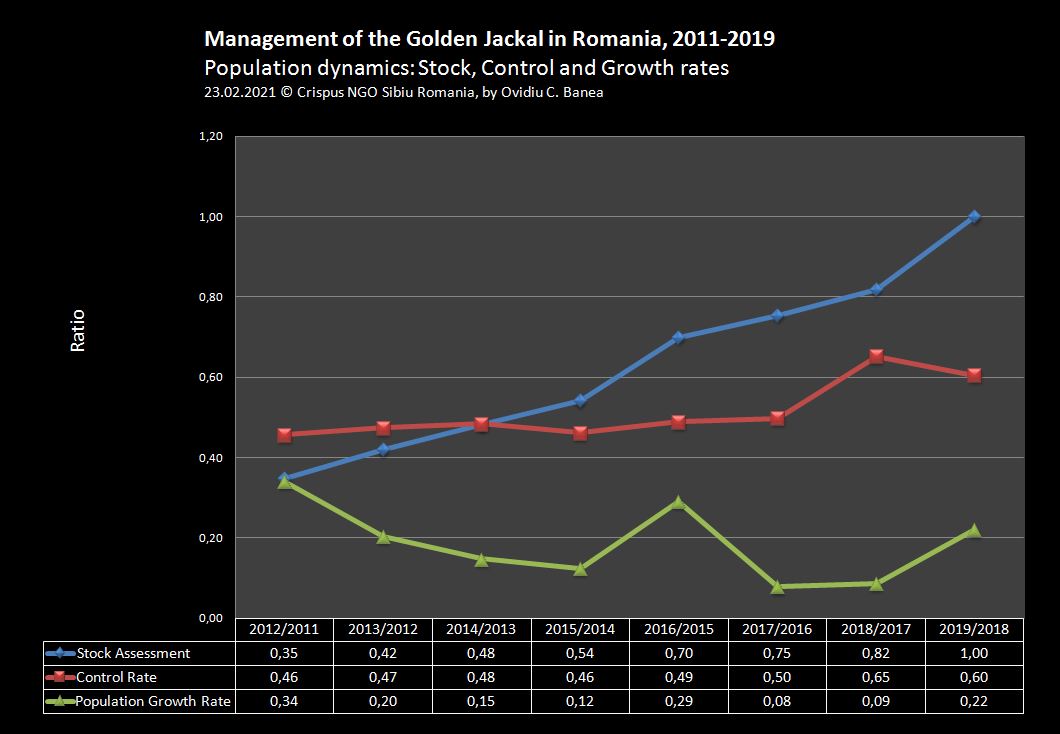
The lethal management and increased control rates are not sufficient to control the golden jackal population size in Romania. Despite increased 65% and 60% control rates the stock assessment increased by 22% during the last hunting season (2019-2020)

During the last week the Ecology Department of NGO Crispus Sibiu Romania started a campaign to make public the difficult management of the golden jackal species in Romania, mostly in the last two hunting seasons when the Romanian Game Management Authority approved harvest quotas (control rate) of 81% and 80%. During the hunting season 2019-2020 a total number of 9.474 jackals were removed.

In Romania, during the last two hunting seasons there is an approved harvest quota of more than 80% from the Stock Assessment.

Proposed and approved Harvest Quota


Realized Quota "Habitats Directive" species of interest Mammals Annex Va
Council Directive 92/43/EEC: Chamois and Golden Jackal Control Rates in Romania


MODEL ROMANIA: Red Foxes (Vulpes vulpes, L.1758) and Golden Jackal (Canis aureus, L.1758) Stock Assessment and Hunting Bag dynamics 2006-2019

Since harvest quotas was lifted to 80% in 2018, the jackals showed first a decreased population growth at 9% (2018-2019) when a pressure of 65% control rate was realized and an increased growing with 22% when the control rate was 60% and 9.747 jackals were harvested.

Golden jackal population dynamics related to management measures in Romania

Game species hunting bag data in Romania 2014-2020


Hilac (Canis aureus moreoticus, I. Geoffroy Saint-Hilaire, 1836), 
Dolj County Romania, February 2021
Photo: Tea Oaches


Read about the full one week campaign!

The last episode (number 5) includes first "International Colloquium regarding European Concerns on jackal population ecology" held in Romania, 23rd of October 2011.

  1. Episode Golden jackal aggressive hunting and poaching in Romania (Aggressive Hunting)
  2. Episode Vulpea si hilacul in Austria, Ungaria, Romania si Bulgaria (Red Foxes and Jackals)
  3. Episode Ce mananca hilacul si dece nu mai au valoare trofeele (A fur costs 150 EUR)
  4. Episode Alerta de Mediu Crispus NGO Sibiu Romania (Environmental Alert)
  5. Episode Letal Management and conservation questions in Romania ("Jackal died", "Hilacul was born")


Ecology Department of Crispus NGO Sibiu Romania

Contact email: crispusngosibiu(at)gmail.com

Monday, February 15, 2021

The Golden Jackal: Legal Framework 2021 applicable to EU


The Jackal is NOT an Invasive Alien Species

The Golden jackal Canis aureus moreoticus is a COMMUNITY INTEREST SPECIES  same like chamois Rupicapra rupicapra

Jackal in Danube Delta, Romania Photo: Carlo Galliani

The golden jackal (​Canis aureus) is a ​Community Interest species​ ("Habitats Directive"92/43/EEC) listed in Annex Va together with pine marten (​Martes martes​), European polecat (Mustela putorius​) and chamois (​Rupicapra rupicapra​). Monitoring of conservation status is an obligation arising from Article 11 of the Habitats Directive for all habitats (as listed in Annex I) and ​species​ (as listed in ​Annex​ II, IV and ​V​) of Community interest.

Consequently, this provision is not restricted to Natura 2000 sites and data need to be collected both in and outside the Natura 2000 network to achieve a full appreciation of the conservation status.

The main results of this monitoring need to be reported to the Commission every six years according to Article 17 of the Directive. Article 14 places a requirement for further surveillance of exploited species of flora and fauna listed in Annex V where necessary. Only after monitoring and scientific reports to the Commission, management measures can be assessed. When management measures are applied in case of ​Community Interest species ​like the golden jackal or chamois a series of hunting methods should be avoided. These hunting methods which are ​prohibited are listed in the Annex VI of the "Habitats Directive" 92/43/EEC. 


GOJAGE posted the work A European Concern? Genetic Structure and Expansion of Golden Jackals (Canis aureus) in Europe and the Caucasus written by Rutkowski R et al in 2015 and published in PLoS ONE which confirms the natural spreading of jackals removing suspicions of being of allochthonous origin in the new successful settlement of natural areas from Estonia. The authors suggest developing cross-boundary strategies for management and documents like those developed for Europe’s other large carnivores.


Based in this Original Article, the EU published a report on their weekly Science for Environment Policy News Alert, Issue 443, 21 January 2016 in which explained the legal situation and the reasons to do not consider jackals an invasive alien species.

CLEANING UP THE CONFUSION In LCIE Note by John Linnell

In June 2015, in Biodiversity and Conservation Journal, in original paper Legal implications of range expansions in a terrestrial carnivore: the case of the golden jackal (Canis aureus) in Europe (here), the authors Arie Trouwborst, Miha Krofel & John D. C. Linnell addressed specific questions regarding the consideration of the golden jackal as classified an (invasive) alien species in countries where it did not formerly occur.  They showed that current international legal obligations limit the freedom of countries to decide how they wish to deal with newly arriving golden jackals. 

Later on, in July 2015, John D.C. Linnell synthesized and resumed these legal implications in a note of  LCIE Large Carnivore Initiative for Europe.

The authors of Legal implications of range expansions in a terrestrial carnivore: the case of the golden jackal (Canis aureus) in Europe. Biodivers Conserv 24, 2593–2610 (2015). https://doi.org/10.1007/s10531-015-0948-y
 
Arie Trouwborst

Miha Krofel

John Linnell

Friday, July 26, 2019

Jackals in Finland, just 4 degrees below the Arctic Circle

Finland and "The Battle of the Jackal" - GOJAGE News

A message to GOJAGE community and to Finland Environmental Board


by Ovidiu C. Banea & Giorgos Giannatos

Reykjavik, 26th of July 2019


Letter from Dr Suvi Viranta addressed to GOJAGE members

26th of July 2019:


Dear GOJAGE members,

They have, or at least this one individual has, arrived to Finland. Below is a photo taken from a car in Eno, Karjala, Eastern Finland.

Best regards,
Suvi

---------------------
Thank You, Suvi!

Thank you for coming to The Battle of the Jackal in Marathon Bay, Attica, Greece during the 2IJS organized by Dr Giorgos Giannatos, last November 2018.
Thank you for your scientific work in the field of jackals! 

Ovi & Giorgos


THE NEWS (the picture) in Finland!

GOJAGE NEWS

On 26th of July 2019 Dr Suvi Viranta-Kovanen announced GOJAGE members the first sighting of the golden jackal in Finland. She works at University of Helsinki as a Senior Lecturer in Anatomy at Faculty of Medicine and Adjunct Professor in Paleobiology at Faculty of Science.

In 2015, we thought that jackals arrived to Karup, Denmark via Finland and Sweden or directly crossing the frozen Baltic Sea. Who knows how they arrived to Denmark? It was Dr Miklós Heltai, (the future director of the 3rd International Jackal Symposium, to be held in GödöllÅ‘, Hungary in 2022) who announced the great news of Jackals in Denmark in September 2015.

Suvi is GOJAGE Responsible and Representative in Finland since she was participating at the 2nd International Jackal Symposium in Greece in November 2018 when she was one of the speakers during "The Battle of the Jackal" with her work "Rediscovering the African Wolf" presented in Marathon Bay, Greece, Attica after 2508 years from "The Battle of Marathon". It was about jackals and African wolves during the "Taxonomy" Session of the 2nd International Jackal Symposium. 


Dr. Nikolai Spassov from NHM Sofia, Bulgaria supported the fact that a wolf-jackal (Canis "lupaster") appears to exist in North Africa from the late Pleistocene. He followed: "However, remains the question: is there a golden jackal (C. aureus or more specific African jackal C. anthus?) together with it in Africa? (Spassov, 2018).

Dr Patricia D Moehlman from Tanzania Wildlife Research Institute (Tawiri) names this species African golden jackal (Moehlman et al, 2018) and convinced everybody that they are jackals.

Suvi & "The Battle of the Jackal" 

in Finland


"The Battle of the Jackal" moved now to Finland since Suvi works internationally with molecular sequencing to assess African wolf distribution in Africa, which remains uncertain due to confusion regarding possible co-occurrence with the Eurasian golden jackal. Canis lupaster differs from all other Canis spp. including the golden jackal in its cranial morphology, while phylogenetically it shows close affinity to the Holarctic grey wolf.


Golden Jackal in European Union, 

Legal framework applicable to Finland

Annex Va and VI from the EU Habitats Directive

From Hatlauf et al, 2016, GOJAGE E-Bulletin

The golden jackal (​Canis aureus) is a ​Community Interest species​ ("Habitats Directive"92/43/EEC) listed in Annex V a together with pine marten (​Martes martes​), European polecat (​Mustela putorius​) and chamois (​Rupicapra rupicapra​). Monitoring of conservation status is an obligation arising from Article 11 of the Habitats Directive for all habitats (as listed in Annex I) and ​species​ (as listed in ​Annex​ II, IV and ​V​) of Community interest.
Consequently, this provision is not restricted to Natura 2000 sites and data need to be collected both in and outside the Natura 2000 network to achieve a full appreciation of the conservation status.
The main results of this monitoring need to be reported to the Commission every six years according to Article 17 of the directive. Article 14 places a requirement for further surveillance of exploited species of flora and fauna listed in Annex V where necessary. Only after monitoring and scientific reports to the Commission, management measures can be assessed. When management measures are applied in case of ​Community Interest species ​like the golden jackal or chamois a series of hunting methods should be avoided. These hunting methods which are​prohibited are listed in the Annex VI of the "Habitats Directive" 92/43/EEC. 


In 2015, when Jackals were first sighted in Denmark

The Battle of  the Jackal in Finland

It is mandatory to know how to communicate with the Finish Scientific Community and the Finish people. We will be ready to inform that the jackals are omnivorous species with an opportunistic behavior and that they arrived using the natural pathways and that they did not harmed (yet) the protected biota in any natural reserve of this planet Earth and that they maintain decent numbers in other new settled areas without exponential grow. They are not Invasive Alien Species.

Jackals have to be monitored in Finland even better than in other countries and policies of management have to start only after the accurate monitoring of this species which remains fragile and have to fight differently for its survival in these boreal biogeographic regions. In Estonia the depredation and the interaction with other con-generics like Red fox is more aggressive as shown by Peep Männil, our Representative in Estonia in a video during the 2IJS in Greece. Together with Mrs Kaja Lotman and Mr Aleksei Lotman from Matsalu NP they could start in a correct way and understanding the complex management of the jackal species.

GOJAGE fully supports Dr Suvi Viranta-Kovanen to represent our informal community and to help for the conservation efforts of the golden jackal in Finland. We are ready to plan our first Bio Acoustic Monitoring survey in the region of Karjala, where the first jackal species sighting to Finland was recorded with the aim to assess the time and the size of this new European golden jackal species cluster, the northernmost in the world.


Prof. Emerit. Heikki Henttonen explaining jackal sighting and the first report of the jackal in Finland to the local media MTV Uutiset in Finnish.

Eno, Karjala, is a municipality with 6,891 inhabitants located in Eastern Finland at Latitude: 62° 48' 18.40" N and a Longitude: 30° 09' 15.19" E.
Canis aureus is now just 4° close to the Arctic Circle.

Welcome to Finland!
We hope soon you will arrive to Iceland.


Dear Suvi!

We hope to see you again in Hungary in 2022 for the 3IJS (3rd Jackal International Symposium).

Or sooner? near Eno, Karjala during the first Finnish jackal B.A.M. survey!
You have our support and all that you need to help the jackal survive in such an environment!


It seems, that we need a boat...
Best regards,


Ovidiu C. Banea & Giorgos Giannatos
with our colleagues from
2IJS Organizing Committee


Thank you again for all your efforts to join the 2IJS! Good luck with the new friend!

Jackal Ecology Task Force (JET-F) supports you and Professor Emeritus Heikki Henttonen!


Giorgos Giannatos (Greece)
Wildlife Biology, PhD
Department of Biology, National and Kapodistrian University of Athens
BIOSFAIRA NGO
Contact: ygiannatos@gmail.com

Ovidiu Constantin Banea (Romania)
Ecology-Biology BSc, Essential and Applied Ecology MSc
NGO Crispus Sibiu, Ecology Department
GOJAGE Co-Founder
Contact: ovidiubanea@gmail.com