Translate

Friday, April 28, 2023

Golden jackal and public awareness in Italy and Romania

New events on the horizon after the 3rd International Jackal Symposium in Gödöllő, Hungary (here) and the World Jackal Day in Austria (here)

Since 1984 when jackals were reported in Italy and Romania, their population reached, officially, a total number of 28.871 individuals in Romania while the Italian population is less than 800-1.200 individuals.

Why? Which is the difference?


Save the dates! 

Cluj-Napoca (RO), Carbonera TV (IT), Milan MI (IT)


Cluj-Napoca, Cluj County, Romania, 8th of May 2023, 16:30H The Institute of Biological Research, Republicii Street, Nr 48 (Program here).

Secția de Ecologie a ONG Crispus Sibiu, WWF România, Institutul de Cercetări Biologice Cluj-Napoca și ACDB Vrancea cu sprijinul Facultății de Biologie și Geologie, Secția Ecologie Sistemică și Conservare (Universitatea Babeș-Bolyai) și al Facultății de Medicină Veterinară (Universitatea de Științe Agricole și Medicină Veterinară Cluj-Napoca) organizează:

PRIMUL COLOCVIU NAȚIONAL DEDICAT SPECIEI DE ȘACAL AURIU ÎN ROMÂNIA

FIRST NATIONAL GOLDEN JACKAL (Canis aureus, L.1758) COLLOQUIUM IN ROMANIA

“Șacalul auriu – parazitologie, monitorizare și management în România”

“The Golden Jackal in Romania – parasitology, monitoring and lethal management.”

RO: Reuniunea va avea loc la Sediul Institutului de Cercetări Biologice, Strada Republicii Nr 48, Cod Postal 400015, în ziua de 8 mai 2023 la ora 16:30, Locuri limitate. Înscrieri de alte prezentări, cu durată de maxim 10 minute, se primesc până la data de 4 mai prin email.

EN: The meeting takes place at The Institute of Biological Research (Address: Republicii Street 48, Cluj-Napoca, Romania). Other presentations (no more than 10 minutes) can be submitted until Thursday, 4th of May 2023 to the following email addresses: crispusngosibiu(at)gmail.com or cpapp(at)wwfdcp.ro. Limited places.

Responsabili eveniment: Ovidiu-Constantin Banea (Crispus Sibiu) și Cristian-Remus Papp (ICB, UBB, WWF) Foto: Alexandra Ion
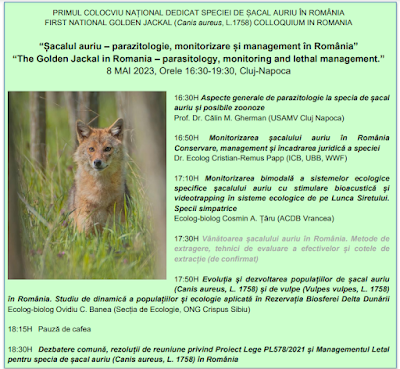

Photo: Alexandra Ion


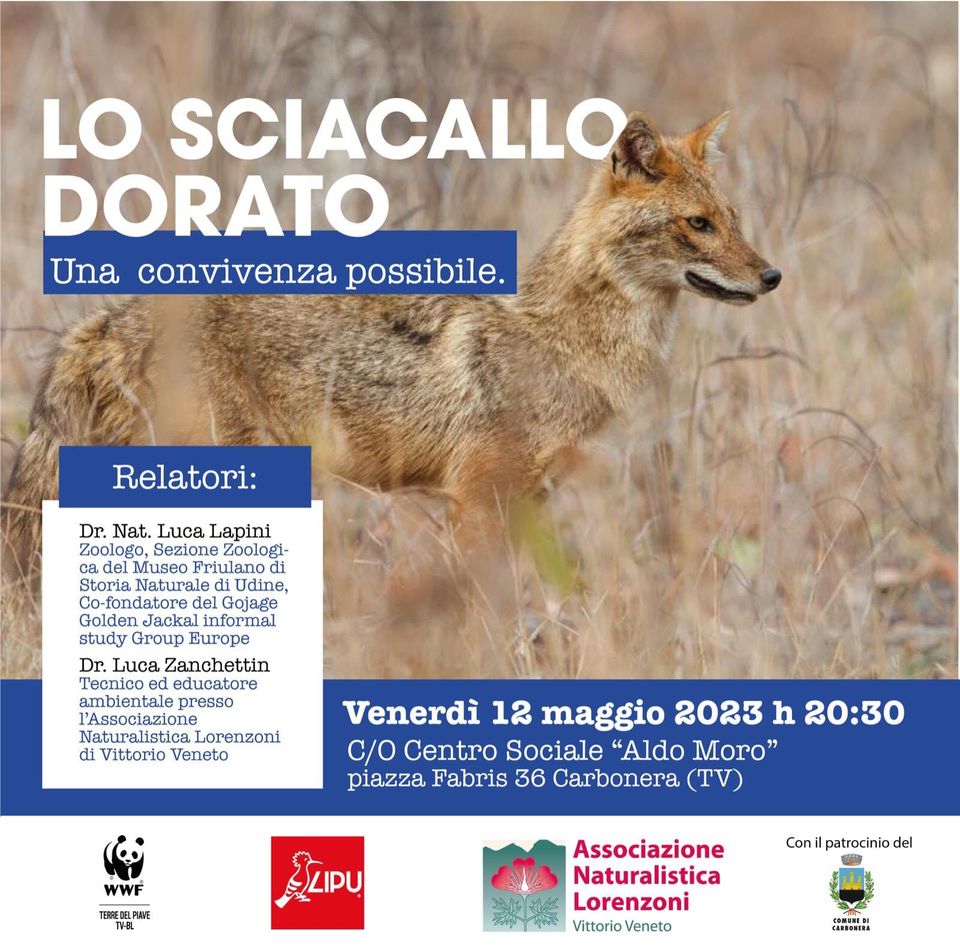
Carbonera, Veneto Region, Italy, 12th of May 2023, 20:30H Centro Sociale "Aldo Moro", Piazza Fabris, Nr 36

"Venerdì 12 maggio 2023, ore 20:30 si svolgerà la conferenza "Sciacallo dorato. Una possibile convivenza" presso il Centro Sociale "Aldo Moro" a Carbonera. Relatori dott. Luca Lapini, zoologo, Sezione Zoologica del Museo Friulano di Storia Naturale di Udine e dott. Luca Zanchettin, tecnico ed educatore ambientale presso l'Associazione Naturalistica Lorenzoni."


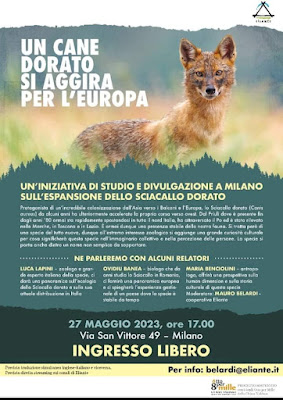
Milano, Lombardia, Italy, 27th of May 2023, 17:30H Via San Vittore, Nr 49 (here)

The last pulsation and dispersal of the golden jackal from the known range of the southeastern part of the Balkan Peninsula started in the 50s and in 1984, the first jackals were recorded in Italy and Romania. 

The fake news and hunters' aggressive attitude against jackals is posing species threats in Central and Eastern European Countries by inducing an erroneous perception to society with such a level that Game Management Authority started to lose control and common sense, elaborating lethal management plans with harvest quotas of more than 80% of the existing population (i.e. Romania). Italy remains a model of human - jackal Cohabitation! In Italy, the golden jackal remains a strictly protected species. The holistic approach to jackal conservation and management includes public awareness. Check ✅ for knowledge and science before management!
Be with us!

Luca Lapini and Ovidiu C. Banea

GOJAGE
28.04.2023

Thursday, December 9, 2021

Golden jackal vagrant was sighted in Tuscany, Italy

The golden jackal on the way to Rome

""""""""""""""""""""""""""""""""""""""""""""""""""""""""""""""""""""""""""""""""""""""""""""""""""""""""""""""

Rome, 7 December 2021 – Unstoppable, the journey of the golden jackal in Italy.

"The Canis aureus left on a distant day dal Gange, after 40 years in our country he arrived in Tuscany. The one of Montemurlo (Prato) it’s just the latest report. The ‘street sweeper’ who eats everything is ‘undermining’ his most direct opponent, the wolf."

Text Source: here, Italy24News

Video Source: here La Repubblica


"How many are and where

But how many are the specimens of this protected species? The Quaderni of the Civic Museum of Natural history of Ferrara have just published a study photographing the presence of the golden jackal with us. At the end of September, write Luca Lapini, Stefano Pecorella, Mauro Ferri and Marta Villa, “the species is currently widespread throughout northern Italy, at least as far south as the Province of Ravenna. It is estimated that they are now present in this vast area of ​​the Italian Peninsula 196-250 specimens divided into at least 37-47 territorial reproductive groups “. Then the sighting of Monemurlo was added. So today the canis aureus is lord in Friuli Venezia Giulia, Veneto, Trentino Alto Adige, Emilia Romagna and Tuscany.

The cities But our jackal does not disdain cities. From Udine to Venice, from Osoppo to Pordenone, from Trieste to Gorizia, from Modena to Parma a Reggio Emilia, “looking for poultry and household waste often collected around public landfills or ecological pitches, which he constantly frequents also to catch rats “(again from the Notebooks). Jackals and wolves
In common they have a passion for chicken coops. End. “We have the feeling that the presence of wolves can only slow expansion of the golden jackal. But evidently, they manage to coexist, at least at low densities – this is the analysis of Lapini, zoologist -. We are witnessing an unprecedented scenario. The beginning of the expansion of the Canis aureus was guaranteed by the killing of the Balkan wolves, reduced to the light in the mid-1950s. Now the expansion is very pronounced, mainly due to the fact that this is a scavenger animal, which finds the main source of resources in man “. And how is he distinguished from the wolf, with whom he continues to be habitually confused?” The most characteristic trait – warns the zoologist – is the white-collar at the base of the neck “.

Protected species

The law 157 of 1992, as the Tolmezzo Forestry, also protects this species. Anyone who kills or captures a specimen risks arrest for two to eight months or a fine from 774 a 2.065 euro. What do they eat
The reputation of scavengers is well deserved. Confirmed by autopsies. Again from the Notebooks of the Ferrara museum: “Whole pieces have been found in various gastric tracts bags of polyethylene used for the delivery of household waste to ecological pitches – swallowed with the entire content, edible or not (leather, cigarette butts, electric wires, etc.) – pieces of plastic, rubber “. The response for the man is without appeal. “We are wasteful”, Lapini’s synthesis."

""""""""""""""""""""""""""""""""""""""""""""""""""""""""""""""""""""""""""""""""""""""""""""""""""""""""""""""


The reproduction of the golden jackal has been demonstrated in Germany

The territorial behavior of the golden jackal has been demonstrated in Germany by genetic studies

Letter from Felix Böcker, M.Sc.

FVA Wildlife Institute, Freiburg

GOJAGE representative in Germany

"We got pictures from a photographer ... I checked the area to confirm the origin... I took my dog with me and she found 4 scats. I installed some camera traps as well. The cameras confirmed the cub. The genetic analysis of all scats resulted in jackal as well. In two of the four scats, the genotyping was successful as well and we identified two animals. A few days later we took genetic samples from a dead sheep (still dead for several days, thus proof for the use of the body but not for being killed) which showed another specimen. Last week my dog found another scat over there which resulted in the fourth specimen. We now have at least 4 jackals and three of them seem to be the pubs of the fourth animal, which is the father (genetically)."

This is a brief resume of what occurred from the 1st of October until the 26th of November 2021.

As presented in a note by the Ministry of Environment (here).


Friday, October 8, 2021

Golden jackal population genetic structure in Slovenia

Golden jackal in Slovenia

GOJAGE Journal Club

by Ovidiu Banea

A very interesting study describing the genetic structure of the golden jackal population in Slovenia was performed by Astrid Vik Stronen, Kristijan Tomljanović, Hubert Potočnik, and other researchers from Hungary, Austria, Croatia, and Serbia. It was published recently in Global Ecology and Conservation (Source: here). 

Tissue samples were collected from Slovenia (n =48), Croatia (n =53), Serbia (n =29), and Hungary (n =22) over the past 15 years. Thirteen samples from Slovenia were analysed from saliva.

It was found that a possible origin of recent jackal dispersion in Slovenia corresponds to sources from Serbia and Hungary and not to the Dalmatian cluster as it was hypothesized by the authors. Some results suggested a third cluster centered in northern Hungary.

The study is crucial to understand the golden jackal population movement pattern in Central Europe and new data from the Eastern countries would be of great interest to further explore the species biogeography in Europe. 

Authors: "However, investigation of samples collected south and east of our study area will be required to obtain a better picture of gene flow within the Balkans and beyond, including the Caucasus (Shakarashvili et al., 2020), and can help determine the main routes of jackal range expansion across Europe."


Source: Stronen et al, 2021: Golden jackal genetic structure from analyses in STRUCTURE for K =3 population clusters. The individual probability of assignment to a given population cluster (qi-values) is shown with pie charts placed at the sampling location of each jackal.  


Source: Stronen et al, 2021


Friday, April 9, 2021

Bioacoustic Monitoring in Romania, Golden jackal survey

Golden Jackal in Romania, holistic approach in specific ecological systems located in hunting terrains and the Danube Delta

BMR 2021, pilot action


by Ovidiu C. Banea

Between the 31st of March 2021 and the 5th of April 2021 took place in Romania bioacoustic monitoring research, BMR2021 in ecological systems specific to golden jackals located in two hunting terrains from western and eastern parts of Romania (FV 2 Cheglevici, Timis county and FV 28 Gura Dobrogei, Constanta county) and in two critical areas in Danube Delta (Caraorman and Letea maritime levees) where the density is controlled regularly by Crispus NGO Sibiu.

Credit: RoHilac 2021 © Ovidiu C. Banea & Cosmin A. Țâru

Photos in detail: Carlo Galliani and Janesz Tarman

Tuesday, April 6, 2021

Intalnire de lucru la Ministerul Mediului Apelor si Padurilor

Letea 4 aprilie 2021, video credit: Ovidiu C. Banea si Cosmin A. Țâru


Initiativa de proiect RoHilac 2021-2024 (Aici)


Thursday, February 25, 2021

The Jackal from Rome crossed the Arctic Circle, 70° North. Welcome to Norway!

First C2-C3 record of a Golden Jackal (Canis aureus, L1758) in Norway 

by Ovidiu C. Banea

25.02.2021

Announcement came from NRK News (here), via Morten Kure Kattenhøj from Denmark On 14th of July 2020 a wild canid was photo trapped in Troms og Finnmark county, Norway. 


Initially, the Norwegian Environmental Protection Agency (SNO) in Lakselv was looking for a Racoon dog in the area. "It took some time to confirm that it was a golden jackal. Now we are also trying to get DNA from it" said the local predator contact in Lakselv, Tore Kåven. Due to winter and bad weather, Kåven has not actively searched for the golden jackal. But the sound, it is unique, he says.

Erik Lund, senior adviser, game section, Norwegian Environment Agency

Senior adviser in the Norwegian Environment Agency, Erik Lund, received the information about the golden jackal only two days ago (23rd of February 2021). Lund said that you never cease to be surprised (NRK News).

Senior researcher John Linnell at the Norwegian Institute for Natural History (NINA) declared for NRK News that the observation of a completely new species up in Finnmark is spectacular. "It does not happen often. And it is extra special when it comes to a species that we never imagined would become part of the Norwegian fauna"


John Linnell at the Norwegian Institute for Natural History (NINA)

GOJAGE

This record remains a C2-C3 evidence (GOJAGE Criteria, Hatlauf et al, 2016). The area where the jackal was observed in Norway it seems as a suitable habitat.

Lakselv is the largest settlement and administrative centre of the municipality Porsanger. Here is the world's northernmost pine forest (Porsanger climate). Its protection is therefore one of the major objectives of Stabbursdalen National Park. 

Stabbursdalen (source) is the most northernly habitat for many species, including black grouse and osprey, and wetlands are important breeding ground, especially for ducks. Old hollow pine trees provide good nesting places for the goldeneye and goosander. Along the river, willow and sedge, with pine woodland behind, support a rich bird life. 

Porsanger (source) is an area of rich and varied bird fauna. Here one can find such species as Pine Grosbeak. Away from the woodlands, it is the surrounding wetlands that have the greatest diversity. During spring, thousands of Red Knots stop to rest and feed along the shores of Porsangerfjord.


                            Photo: Tore Kåven